Chuối không phải là loại trái cây “có hại” đối với người bệnh tiểu đường; tác động của chúng đến lượng đường trong máu phụ thuộc vào độ chín, khẩu phần, giống chuối và những gì bạn ăn kèm.
Vì sao độ chín lại quan trọng
Khi chuối chín, một phần tinh bột của chúng chuyển hóa thành đường tự do, vì vậy chuối xanh thường có chỉ số đường huyết thấp hơn so với chuối chín kỹ. Một nghiên cứu kinh điển đã chỉ ra rằng chuối chưa chín tạo ra phản ứng đường huyết thấp hơn so với chuối chín quá.
Phần và bối cảnh
Ngay cả những loại trái cây có chỉ số đường huyết thấp cũng có thể làm tăng lượng đường trong máu nếu ăn với lượng lớn, vì vậy một quả chuối nhỏ rất khác so với hai quả chuối lớn. Kết hợp chuối với protein, chất xơ hoặc chất béo lành mạnh có thể làm giảm sự tăng đột biến lượng đường trong máu, ví dụ như với sữa chua, các loại hạt hoặc bơ đậu phộng.
Bài học thực tiễn
Đối với nhiều người mắc bệnh tiểu đường, chuối vẫn có thể được đưa vào chế độ ăn nếu lựa chọn cẩn thận: ăn khẩu phần nhỏ hơn, chọn chuối chưa chín và kết hợp hợp lý với các món ăn khác. Nếu việc kiểm soát đường huyết tốt, chuối xanh thường là lựa chọn an toàn hơn, trong khi chuối quá chín có thể làm tăng đường huyết nhanh hơn.
Một ví dụ đơn giản
Một quả chuối nhỏ, hơi xanh ăn kèm với sữa chua Hy Lạp không đường thường là lựa chọn tốt hơn cho việc kiểm soát lượng đường trong máu so với một quả chuối lớn, quá chín ăn riêng.
#Diabetes: Not “Bad,” Just Needs Context
Banana is one of the most frequently misunderstood fruits in diabetes nutrition.
It is often over-restricted due to its #carbohydrate content, despite its #variable, context-dependent #glycemic #impact.
From a clinical diabetology perspective, banana should be assessed based on #ripeness, #glycemic #load, #fiber matrix, #portion size, and food #context—rather than a blanket “good or bad” label.
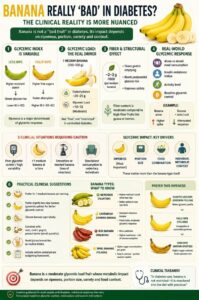
1. #Glycemic #Index is Variable, Not Fixed:
– Banana has a moderate and dynamic GI depending on ripeness:
🟢 Less ripe: higher resistant starch → slower glucose rise
🟡 Fully ripe: higher free sugars → faster absorption
– Ripeness is a major determinant of glycemic response.
2. Glycemic Load:
– A medium banana provides: ~20–25 g carbohydrates
– Glycemic load: moderate
– Not low enough to be “free,” not high enough to be automatically restricted in controlled diabetes.
3. Fiber & Structural Effect:
~2–3 g fiber per medium banana
– Pectin is higher in less ripe stages
#Effects:
– Slows gastric emptying
– Blunts postprandial glucose rise
– Improves satiety
– But fiber density is only moderate compared with high-fiber fruits like guava or berries.
4. Real-World Glycemic Response:
Depends on:
– Alone vs mixed meal consumption
– Insulin resistance status
– Activity level
– Baseline glycemic control
👉 Food combinations often matter more than GI values.
#Example:
– Banana alone → higher spike
– Banana + nuts/curd → attenuated response
⚠️ 5. Clinical Situations Requiring Caution:
– Poor glycemic control / high variability
– Smoothies or mashed banana (loss of structure)
– Standalone consumption in sedentary individuals
6. Practical Clinical Suggestions:
– Prefer ½–1 medium banana per serving
– Prefer slightly #less #ripe #banana (greenish-yellow) for better glycemic control
– Choose banana type wisely:
🟢 Nendran (less ripe): higher resistant starch, better early-stage option
🟢 Cavendish (common banana): standard, predictable response
🔴 Red banana: more palatable, risk of overconsumption
🔴 Small bananas (yelakki): easy to overeat → portion caution needed
Combine with:
– Nuts
– Peanut
🔴 Avoid juices/smoothies as routine intake
🟢 Always include within carbohydrate budgeting framework
Banana is not a “bad fruit” in diabetes.
It is a moderate glycemic load fruit whose metabolic impact depends on ripeness, portion size, variety, and food context.
In diabetes care, banana is not restricted—it is structured into the diet with precision.
#DiabetesCare #ClinicalDiabetology #NutritionInDiabetes #GlycemicControl #MetabolicHealth #EvidenceBasedMedicine #DiabetesEducation #FruitInDiabetes #PrecisionNutrition #HbA1cControl
Chăm sóc bệnh tiểu đường, Bệnh tiểu đường lâm sàng, Dinh dưỡng trong bệnh tiểu đường, Kiểm soát đường huyết, Sức khỏe chuyển hóa, Y học dựa trên bằng chứng, Giáo dục về bệnh tiểu đường, Trái cây trong bệnh tiểu đường, Dinh dưỡng chính xác, Kiểm soát HbA1c
(St.)
Ý kiến bạn đọc (0)