
Lựa chọn mặt bích là quá trình lựa chọn loại, kích thước, lớp/vật liệu phù hợp và mặt đối với kết nối đường ống hoặc thiết bị sao cho an toàn, kín rò rỉ và phù hợp với điều kiện sử dụng.
Các yếu tố chính cần xem xét
-
Điều kiện dịch vụ: áp suất và nhiệt độ vận hành tối đa xác định xếp hạng mặt bích cần thiết (ví dụ:ample, ASME “Class” 150–2500 hoặc ISO “PN” 6–40).
-
Kích thước ống và lỗ khoan: đường kính danh nghĩa mặt bích (NPS hoặc DN) phải phù hợp với vòi phun của ống hoặc thiết bị, và loại lỗ khoan (trượt, cổ hàn, mối hàn ổ cắm, v.v.) phải phù hợp với nhu cầu dòng chảy và chế tạo.
-
Loại mặt bích: các loại phổ biến bao gồm cổ hàn (tính toàn vẹn cao nhất, áp suất cao), trượt (rẻ hơn, áp suất vừa phải), mối hàn ổ cắm, ren và mặt bích nối vòng; mỗi loại có yêu cầu mối hàn và độ tin cậy mối nối khác nhau.
Vật liệu và tiêu chuẩn
-
Vật liệu (thép cacbon, thép không gỉ, hợp kim, v.v.) phải chống ăn mòn và tác động nhiệt của chất lỏng; ví dụ, mặt bích SS304 / SS316 phổ biến trong các dịch vụ thực phẩm, dược phẩm và hóa chất.
-
Tiêu chuẩn (ASME B16.5, B16.47, ISO 7005, v.v.) xác định kích thước, xếp hạng áp suất-nhiệt độ và đánh dấu; thiết kế phải tuân theo mã đường ống có liên quan (chẳng hạn như ASME B31.3) để loại mặt bích được chọn an toàn cho áp suất và nhiệt độ thiết kế.
Các bước lựa chọn thực tế
-
Xác định áp suất, nhiệt độ và chất lỏng thiết kế (bao gồm cả tính ăn mòn).
-
Chọn vật liệu mặt bích và tìm bảng xếp hạng áp suất-nhiệt độ thích hợp (từ ASME B16.5 hoặc tương đương) để chọn loại tối thiểu.
-
Chọn loại mặt bích (ví dụ: cổ hàn cho các đường áp suất cao quan trọng, trượt cho các đường không tới hạn áp suất thấp đến trung bình) và mặt đối diện (mặt nhô lên, mặt phẳng, RTJ).
hna Nand OjhaKrishna Nand Ojha
• 1stPremium • 1st
Senior Manager, Qatar | ASQ: CMQ/OE, CSSBB, CCQM | CQP MCQI | IRCA ISO LA 9001, 14001 & 45001 | CSWIP 3.1, BGAS Gr.2, NEBOSH IGC | PMI: PMP, RMP, PMOCP |PhD, MBA, B.Tech, B.Sc |Quality, Improvement, Procurement SpecilistSenior Manager, Qatar | ASQ: CMQ/OE, CSSBB, CCQM | CQP MCQI | IRCA ISO LA 9001, 14001 & 45001 | CSWIP 3.1, BGAS Gr.2, NEBOSH IGC | PMI: PMP, RMP, PMOCP |PhD, MBA, B.Tech, B.Sc |Quality, Improvement, Procurement Specilist
6h • 6 hours ago • Visible to anyone on or off LinkedIn
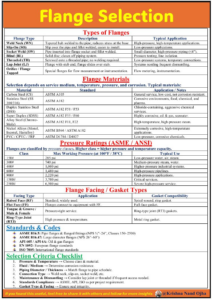
🔍 Flange Selection — One Wrong Choice Can Cause Leaks, Failures, and Costly Shutdowns
Flanges look simple… but selecting the wrong type, material, or rating can lead to serious operational risks.
Pressure, temperature, corrosion, and maintenance requirements all matter & each decision affects reliability.
Here’s a practical engineer’s guide to getting flange selection right.
🔴 Start with the Right Flange Type
Your service conditions usually determine the type:
🔹Weld Neck (WN) → Best for high pressure & high temperature. Excellent fatigue resistance.
🔹Slip-On (SO) → Easier alignment, lower cost, suitable for low–moderate pressure.
🔹Socket Weld (SW) → Small-bore, high-pressure piping (typically ≤ 2–4″).
🔹Blind (BL) → Isolation, hydrotest, future expansion points.
🔹Threaded (TH) → Low-pressure utilities where welding is not preferred.
🔹Lap Joint (LJ) → Frequent dismantling, lined piping, rotation needed.
🔹Orifice / Tapped → Flow measurement and instrumentation.
🟣 Material Selection is Driven by Service
Choosing the wrong material is one of the most common mistakes.
🔹Carbon Steel (ASTM A105) → General service, non-corrosive fluids
🔹Stainless Steel (ASTM A182 F304/316) → Corrosive environments, chemicals
🔹Duplex / Super Duplex → Seawater, offshore, chloride service
🔹Chrome-Moly (F11 / F22) → High temperature steam systems
🔹Nickel Alloys (Monel, Inconel, Hastelloy) → Extreme corrosion & temperature
🔹PVC / FRP → Low pressure corrosive chemical service
Always check corrosion allowance, galvanic compatibility, and operating temperature.
🟠 Pressure Class Matters More Than You Think
Higher class = higher pressure + temperature capability.
Common classes:
🔹Class 150 → Utilities, water, air
🔹Class 300 → General process service
🔹Class 600 → High-pressure piping
🔹Class 900 → Critical hydrocarbon service
🔹Class 1500 → Severe duty
🔹Class 2500 → Extreme pressure systems
Never select class based on pressure alone — temperature reduces allowable limits.
🟡 Facing Type Controls Leak Tightness
Gasket compatibility is critical.
🔹Raised Face (RF) → Most common, spiral wound gasket
🔹Flat Face (FF) → Cast iron / non-metallic flanges
🔹Tongue & Groove → Better alignment, tighter seal
🔹Male & Female → Pressure-tight applications
🔹RTJ (Ring Type Joint) → High pressure, high temperature, critical service
RTJ is preferred in offshore, high-pressure hydrocarbon systems.
🟣 Follow the Correct Standards
Typical codes engineers use:
🔹ASME B16.5 — Standard flanges
🔹ASME B16.47 — Large diameter flanges
🔹API 6A — Oil & gas wellhead flanges
🔹EN 1092 — European flanges
🔹ISO 7005 — International standard
Always match flange, gasket, bolts, and pipe class.
✨ Found this helpful?
Đường ống, Mặt bích, ASME, Đường ống
(St.)
Chia sẻ
Ý kiến bạn đọc (0)