
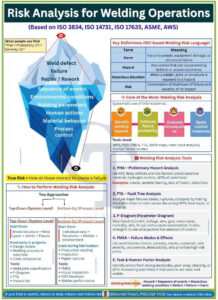
🔑 Key Definitions (ISO-Based Welding Risk Language)
Harm -Injury to people, equipment damage, or structural failure
Hazard – Any source that can cause welding defects or unsafe conditions
Hazardous Situation – When a welder, joint, or structure is exposed to a hazard
Risk – Combination of likelihood of failure and severity of its impact
➡️ True Risk = How all these interact to create a failure
Risk Formula:
👉 Risk = Probability (P) × Severity (S)
🔗 Welding Risk Chain
Hazard → Sequence of events → Hazardous welding condition → Defect → Failure → Harm
What people usually see first = Defect
What actually matters most = Chain behind it
🧠 Core of the Work: Welding Risk Analysis
Systematic use of information to:
• Identify welding hazards
• Evaluate consequences
• Estimate failure probability
• Apply control measures
⚠️ Common Weld Failures to Analyze
• Lack of fusion
• Porosity
• Cracks
• Undercut
For each defect, assess:
• Severity
• Occurrence
• Detectability
➡️ Prioritize high-risk joints, not just visible defects
🧩 Factors Influencing Welding Risk
• Welding parameters
• Environmental conditions
• Material behavior
• Human actions
• Process control
• Repair / rework history
🧰 Welding Risk Analysis Tools
WPS / PQR – Control and qualification
FMEA – Failure Modes & Effects Analysis
FTA – Fault Tree Analysis
P-Diagram – Input / noise / output mapping
Weld maps – Risk-based joint identification
Heat input analysis – Crack & distortion control
Human-factor studies – Error prevention
🔧 How to Perform Welding Risk Analysis
Two Complementary Approaches
⬆️ Top-Down Approach (System Level)
Start from:
Whole structure → Weld types → Joints → Passes
Used early in projects:
• Design review
• Welding procedure selection
• Code compliance
Tools:
• Weld joint classification
• P-Diagram
• FTA
• Hazard list
⬇️ Bottom-Up Approach (Process Level)
Start from:
Individual weld → Parameters → Welder → Environment
Used during fabrication:
• Production welding
• Inspection
• Repair control
Tools:
• FMEA
• Visual inspection
• NDT feedback
• Welder performance analysis
🔍 Key Risk Analysis Methods Explained
1️⃣ PHA – Preliminary Hazard Analysis
Identify likely defects and risk factor such as:
• Crack-sensitive materials
• Hydrogen control issues
• Difficult welding positions
Examples:
Cracks, lamellar tearing, lack of fusion, distortion
2️⃣ FTA – Fault Tree Analysis
Start from major failures (leaks, rupture)
Trace backward to root causes like:
• Wrong WPS
• Incorrect heat input
• Material mismatch
3️⃣ P-Diagram (Parameter Diagram)
Inputs: current, voltage, wire, shielding gas
Noise: wind, humidity, skill level
Outputs: penetration, fusion, strength
➡️ Shows how welds go out of control
4️⃣ FMEA – Failure Modes & Effects
Quantify risk using Severity × Occurrence × Detection
5️⃣ Task & Human-Factor Analysis
📘 Standards Referenced
ISO 3834
ISO 14731
ISO 17635
ASME
AWS
(St.)
Ý kiến bạn đọc (0)